Agentic AI: The Next Leap in Artificial Intelligence
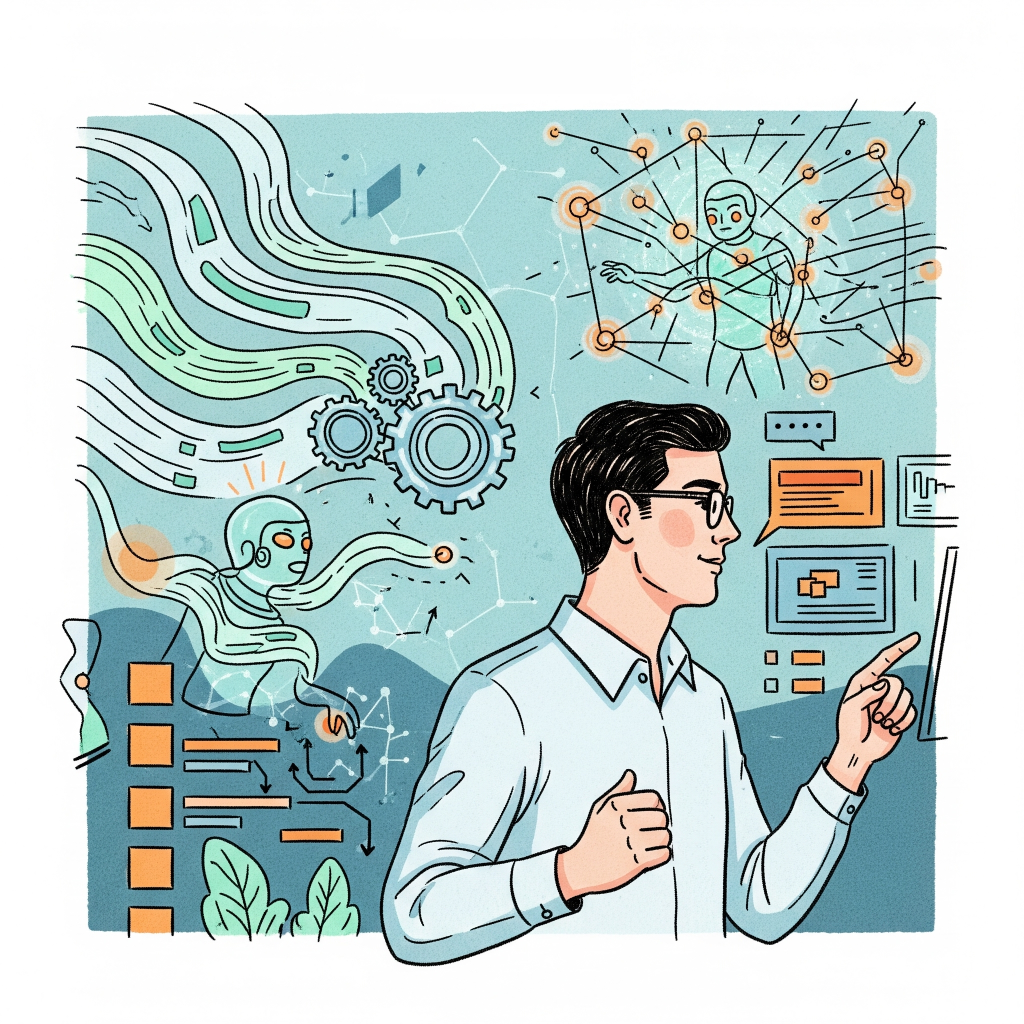
Artificial Intelligence has come a long way, from chatbots to powerful generative models that can write essays, generate images, and even compose music. Agentic AI is the next logical and powerful step. Think of it less as a tool you command (like GenAI) and more as a trusted, autonomous partner that can execute complex tasks on your behalf.
What Is Agentic AI?
At its core, Agentic AI refers to AI systems that can independently/autonomously make decisions, set goals, and take actions to achieve those goals. Unlike traditional generative AI, which waits for a prompt and then responds, Agentic AI behaves more like a human that can initiate tasks, adapt to changing conditions, and manage complex workflows with minimal human input. Agentic AI achieves this by being able to perceive its environment or “context”, create a plan, and take a series of actions to achieve a desired outcome.
Think of it as the difference between a GPS and a self-driving car:
A GPS (like traditional generative AI) gives you directions when you ask for them. You still have to drive, make turns, and adjust if you miss an exit.
A self-driving car (like Agentic AI) takes your destination, plans the route, navigates traffic, adapts to road conditions, and gets you there—without needing you to steer at every step. It doesn’t just give you information; it takes action to achieve your goal.
As another example, think of Agentic AI as a high-achieving intern who you can simply give a high-level objective to, and they can figure out the necessary steps, access the right tools and information, and report back upon completion.
What Are Autonomous Reasoning Loops?
A key feature that powers Agentic AI is the autonomous reasoning loop: a cycle where the AI perceives, plans, acts, and reflects repeatedly until it achieves a goal.
Here’s how it works:
Perception: Understands the current situation or task by taking in information from various sources like databases, real-time data feeds, user inputs, and other AI systems.
Plans: Based on the goal and the information it gathered, it creates a set of steps to take next.
Acts: Executes an action (e.g., searching the web, calling an API, writing code).
Reflects: The agent analyzes the outcome of its action, critiquing its own performance to identify errors or potential improvements.
Repeats: Uses the new information to decide the next step.
This loop continues autonomously, allowing the AI to adapt and improve its strategy in real time.
Public Sector Example use of Agentic AI
To illustrate the tangible impact of Agentic AI, let’s consider a real-world public sector challenge: coordinating disaster response. This is a scenario where speed is critical, but so is accountability.
In the chaotic aftermath of a hurricane, a state-level emergency management agency is inundated with requests for resources, situational reports from the field, and citizen inquiries. A human team, no matter how dedicated, can quickly become overwhelmed by the sheer volume of data.
Now, let’s introduce an Agentic AI for Disaster Response. An agency director could give it a high-level directive: “Analyze the situation in County X and recommend the most effective distribution plans for medical supplies to critically affected areas.”
Here’s how this collaborative system would go to work:
• Perception: The agent would start gathering data from multiple sources: real-time weather feeds, damage reports from first responders, inventory levels from state and federal warehouses, hospital capacity data, and even sentiment analysis from social media to identify pockets of urgent need.
Planning & Analysis: The AI would then rapidly analyze this data to formulate several optimal distribution plans. It would identify the hardest-hit locations, determine the most critical medical needs (e.g., trauma kits, insulin, clean water), locate the nearest available supplies, and map out the most efficient and safest delivery routes, accounting for road closures and ongoing hazards.
Human-in-the-Loop Decision Point: This is a critical step. Instead of acting autonomously, the agent presents its findings to the human commander. On a single dashboard, the agency director sees:
Recommended Courses of Action: For example, “Plan A: Prioritizes hospitals with ICU capacity, ETA 4 hours. Plan B: Fastest overall delivery to 3 primary shelters, ETA 2.5 hours.”
Supporting Rationale: Clear, concise data backing each recommendation. “Plan A serves 500 more critical patients but requires a National Guard escort due to a partially flooded route.”
Resource Overview: A real-time view of the supplies and transportation assets required for each plan.
Interactive Controls: Simple “Approve Plan A,” “Approve Plan B,” or “Modify” buttons.
The human leader can now apply their experience, strategic judgment, and ethical considerations to make the final call. They might know something the AI doesn’t—perhaps a political consideration or a recent, on-the-ground development not yet in any database. They are in complete control.
Action (Upon Human Approval): Once the director clicks “Approve,” the agent executes the chosen plan. It automatically generates and sends resource requests to the appropriate depots, dispatches transportation assets with the optimized routes, sends automated alerts to receiving hospitals, and provides a real-time, consolidated dashboard of the entire operation back to the director
How Can Agentic AI Be Used?
Agentic AI is already being explored in a variety of domains:
Business Automation
Automating end-to-end workflows like onboarding new employees, managing invoices, or handling customer support tickets.
Example: An AI agent that monitors your inbox, drafts replies, schedules meetings, and updates your CRM.
Software Development
Writing, testing, and deploying code with minimal human oversight.
Example: An AI that takes a feature request, writes the code, runs tests, and submits a pull request.
Cybersecurity
Detecting threats, investigating incidents, and deploying countermeasures autonomously.
Example: An agent that identifies a phishing attempt, isolates the affected system, and notifies the security team.
Personal Productivity
Managing your calendar, emails, and to-do lists proactively.
Example: An AI that notices a scheduling conflict and resolves it by negotiating new times with attendees.
Scientific Research
Running simulations, analyzing data, and generating hypotheses.
Example: An AI agent that reads new research papers, identifies gaps, and proposes experiments.
Generative vs Agentic AI
The following table highlights key differences between Generative AI, which focuses on content creation, and Agentic AI, which emphasizes autonomous action and goal achievement.
Feature
Generative AI
Agentic AI
Primary Function
Produces content (text, images, code)
Takes actions to achieve goals
Initiative
Reactive (responds to prompts)
Proactive (acts autonomously)
Memory
Often stateless
Maintains context and memory
Planning
Limited or none
Multi-step reasoning and planning
Examples
ChatGPT, Copilot, DALL-E
AutoGPT, Devin, ReAct, MCP
Risks and Considerations
Leveraging Agentic AI comes with its own set of challenges, including ensuring data security, maintaining oversight and control, and fostering trust in these autonomous systems. Agentic AI introduces new challenges:
Autonomy risks: Poorly defined goals can lead to unintended consequences.
Security: Agents with access to tools and systems must be tightly controlled.
Ethics: Who is accountable when an AI agent makes a mistake?
That’s why transparency, oversight (i.e., “Human in the loop”), and robust testing are critical as we integrate these systems into our lives and businesses.
Final Thoughts
Agentic AI represents a major evolution in how we interact with machines. It’s not just about making AI smarter—it’s about making it more useful, more adaptive, and more aligned with human goals. As we move forward, the key will be designing agents that are not only capable but also trustworthy.
We’re entering an era where AI won’t just answer our questions—it will help us ask better ones, solve harder problems, and do more with less effort.
Register today for the 3-Week Virtual Agentic AI Summit: