Beyond Antivirus: The Critical Role of Endpoint Detection & Response (EDR) and eXtended Detection & Response (XDR) in Modern Defenses
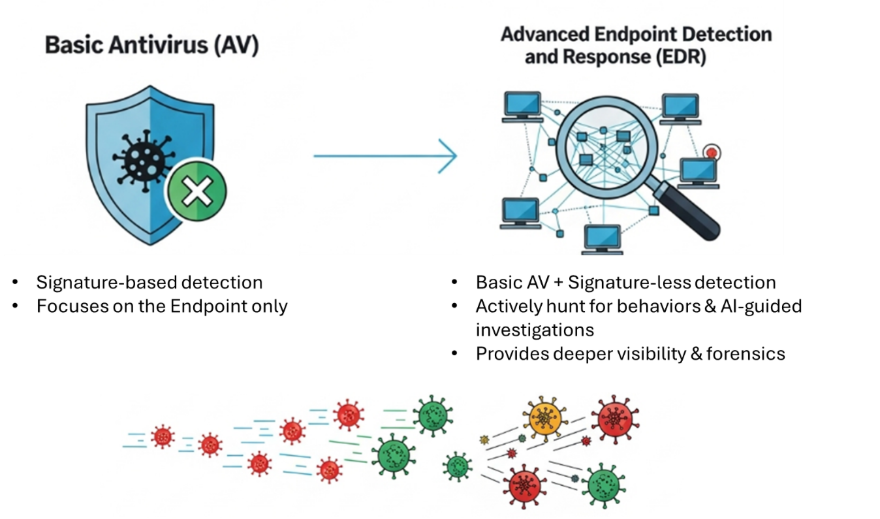
For decades, signature-based antivirus (AV) served as the primary defender of the endpoint. Its operational model was straightforward: identify malicious files based on a known set of digital fingerprints (i.e., “signatures”) and block them. While effective against widespread, known malware, this approach is insufficient for the current threat environment. Adversaries now routinely employ sophisticated techniques such as fileless malware, zero-day exploits, and polymorphic code that leave no conventional signature to detect. In fact, many successful breaches today don’t involve malware at all; instead, attackers gain access by authenticating legitimately with compromised usernames and passwords.
To effectively counter these methods, security postures must evolve from simply blocking known threats to actively hunting for malicious behaviors and activities. This is the domain of Endpoint Detection and Response (EDR) and its successor, Extended Detection and Response (XDR). These capabilities represent a shift in endpoint security philosophy, focusing on visibility, behavioral analysis, and rapid remediation.
Endpoint Detection and Response (EDR): The New Baseline
EDR provides the tools necessary to monitor, detect, and remediate malicious activity directly on endpoints. Unlike traditional AV, which primarily asks, “Is this file bad?” EDR asks, “Is this behavior normal?” By continuously collecting and analyzing telemetry from endpoints like process execution, network connections, and registry modifications, EDR solutions can identify and flag suspicious activity patterns that indicate a compromise, even when no known malicious file is present.
The Department of Defense’s Zero Trust framework outlines a clear objective for EDR implementation: to actively investigate and respond to threats originating from network-connected endpoints. This proactive stance is designed to detect advanced threats that are undetectable by a traditional antivirus program, optimize incident response times, and discard false positives.
A critical aspect of deploying EDR is its integration with other security components. For instance, the Zero Trust Activity 2.7.1 “Implement Endpoint Detection & Response (EDR) Tools and Integrate with C2C” underscores that EDR is not a siloed solution. Comply-to-Connect (C2C) systems are designed to confirm a device’s compliance status before granting it access to network resources. By integrating EDR, the C2C gateway can make more intelligent access decisions. If the EDR solution detects an active threat or anomalous behavior on an endpoint, that telemetry can be used by the C2C system to quarantine the device or block access entirely, preventing lateral movement and containing the threat before it spreads.
Extended Detection and Response (XDR): A Holistic View
While EDR significantly enhances endpoint security, its focus remains on the endpoint device. Advanced attacks, however, often traverse multiple security domains (such as email, cloud, network, and endpoint). An adversary might begin with a phishing email (email security gateway), move to an endpoint (EDR), and then attempt to access data in a cloud environment (cloud security tools). Investigating such an incident requires security teams to manually piece together data from disparate, non-integrated systems.
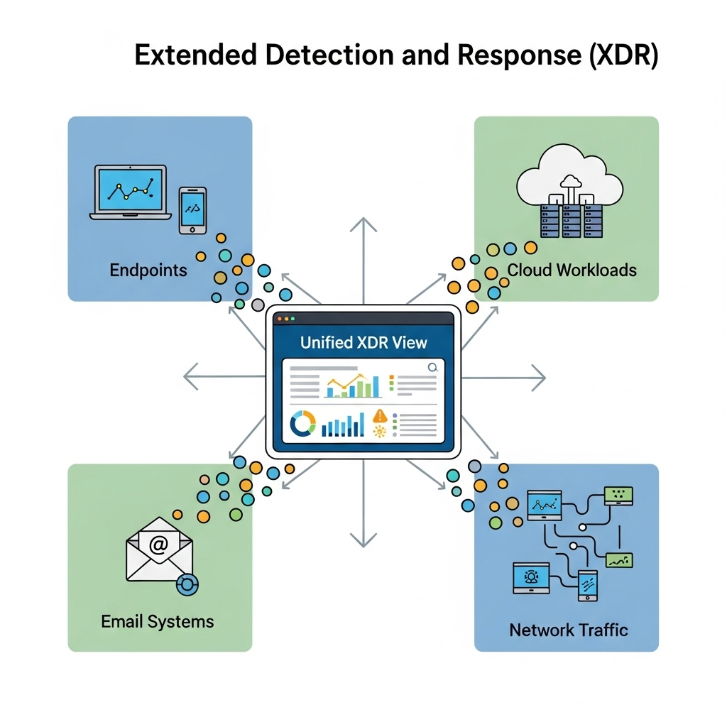
XDR addresses this challenge by extending the principles of detection and response beyond the endpoint to encompass the broader IT environment. An XDR solution ingests and correlates data from multiple security layers including endpoints, cloud workloads, email systems, and network traffic, to provide a unified view of the threat landscape.
The DoD’s Zero Trust Activity 2.7.2 “Implement Extended Detection & Response (XDR) Tools and Integrate with C2C Part 1” takes EDR’s endpoint telemetry and integrates it with data from other security pillars – explicitly mentioning network, cloud services, and applications. These cross-pillar integration points are identified and prioritized based on risk, ensuring XDR provides the most valuable correlated insights.
The move to XDR enables significantly faster threat detection and remediation by automatically correlating related alerts from different sources into a single, comprehensive incident. This provides a holistic view that allows for a more coordinated response. For example, an XDR platform could correlate an alert from an email security gateway about a malicious attachment with an EDR alert showing a suspicious PowerShell script executing on the recipient’s machine, and a cloud security alert indicating an attempt to access a sensitive data repository with that user’s credentials.
This consolidation of analytics and correlation capabilities provides a powerful dataset that can be fed into a Security Information and Event Management (SIEM) system for further analysis and long-term retention. The DoD framework recognizes this as a key maturation step, where threat alerting is expanded to include advanced data sources from XDR, User & Entity Behavior Analytics (UEBA), and User Activity Monitoring (UAM) to improve the detection of anomalous activity.
The Strategic Value of EDR and XDR
Implementing EDR is no longer an optional upgrade; it is the foundational requirement for modern endpoint protection. It provides the visibility and response capabilities necessary to counter advanced threats that bypass traditional defenses. For organizations looking to mature their security operations, XDR offers the next logical evolution. By breaking down the silos between security tools, XDR provides the comprehensive visibility needed to detect and respond to complex attacks across the entire IT ecosystem.
Ultimately, the goal is to shift from a reactive security model to a proactive, analytics-driven one. EDR and XDR are not just tools; they are data-gathering engines that provide the critical telemetry needed to power a host of other Zero Trust capabilities, from dynamic access control to behavioral analytics. For cybersecurity professionals tasked with defending their organizations, embracing this evolution is essential for building a resilient and adaptive security architecture.