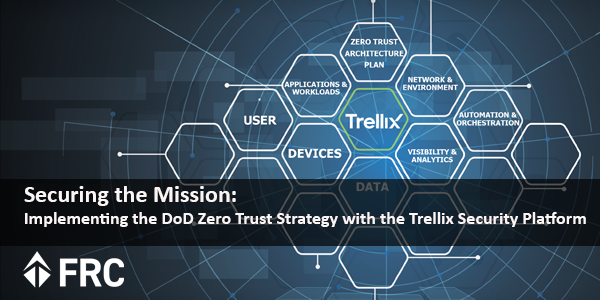
Securing the Mission: Implementing the DoD Zero Trust Strategy with the Trellix Security Platform
January 14, 2026
12 Things to Do, See, and Eat While at Rocky Mountain Cyberspace Symposium (RMCS) Feb 2-5
January 26, 2026Threat Modeling and Threat Hunting: Testing your Zero Trust Architecture with AttackIQ
The Department of Defense (DoD) components are mandated to achieve “Target-level” Zero Trust maturity by 2027.
Zero Trust (ZT) is not a single product, but a paradigm shift in how the DoD authenticates, authorizes, and monitors every user, device, workload, and data flow. Implementing these controls is only the first step. To achieve true mission resiliency, organizations must prove these controls function as intended under realistic conditions.
This is where the AttackIQ Adversarial Exposure Validation (AEV) platform becomes a critical enabler for the DoD’s Zero Trust Roadmap.

The Role of Continuous Validation
Achieving Zero Trust maturity is an iterative process. The DoD Zero Trust Reference Architecture provides a specialized set of security controls (based on NIST SP 800-53) and phased activities required to reach Target and Advanced levels of maturity. AttackIQ helps agencies operationalize this approach by continuously testing and verifying these controls across the seven pillars of the DoD Zero Trust Maturity Model.

The DoD emphasizes that implementing ZT requires rethinking how to use existing infrastructure to achieve security by design. By emulating real-world adversary behavior, AttackIQ closes the gap between simply having a security tool and understanding its actual effectiveness in a live environment.
Enabling Threat Modeling and Threat Hunting
The DoD Zero Trust Overlays identify several “Execution Enablers”—cross-cutting, capabilities and activities that address culture, governance, and strategy. Within these enablers, specific activities like Threat Modeling and Threat Hunting are highlighted as essential for identifying system vulnerabilities and threat vectors.
Operationalizing Threat Modeling
Threat modeling involves analyzing an architecture or design to identify potential security risks before they can be exploited. AttackIQ enhances this process by providing a library of pre-built attack scenarios mapped to the MITRE ATT&CK framework. Instead of treating threat modeling as a static, paper-based exercise, AttackIQ allows engineers to run controlled simulations that produce empirical data. This provides the evidence sufficient for the risk-based decision-making required by the Overlays, ensuring that zero trust components like Policy Decision Points (PDPs) and Policy Enforcement Points (PEPs) are architected correctly to handle evolving threats.
Empowering Threat Hunting
Threat hunting is an active defense approach that involves searching for advanced threats that have already bypassed existing controls. The Overlays document defines this as a proactive method supporting the “Presume Breach” tenet. AttackIQ facilitates threat hunting by replaying known adversary tactics, techniques, and procedures (TTPs). This allows security teams to validate if their telemetry and analytics—critical components of the Visibility & Analytics Pillar—are actually providing the alerts necessary to catch a stealthy attacker. By using AttackIQ to “replay” an attack, hunters can verify that their SIEM and XDR tools are collecting the right forensic artifacts to identify an intrusion.
AttackIQ and Zero Trust Activity 7.5.1

In the Visibility & Analytics Pillar, Capability 7.5: Threat Intelligence Integration is a key requirement for moving toward ZT maturity. Specifically, Activity 7.5.1 (Cyber Threat Intelligence Program Part 1) requires DoD components to establish a program that catalogs and manages threat information, including public vulnerabilities, to provide the necessary context for decision-making.
AttackIQ directly enables Activity 7.5.1 by operationalizing threat intelligence. A CTI program is only effective if its findings can be used to improve security posture. AttackIQ takes the intelligence gathered in Activity 7.5.1, such as indicators of compromise (IoC) and new adversary techniques, and turns them into executable validation tests.
By integrating these TTPs into a continuous testing cycle, AttackIQ allows organizations to:
- Validate Intelligence: Ensure that the specific threats identified by the CTI program are actually detectable by existing security stacks.
- Reduce Time-to-Detection: Shorten the window between the discovery of a new vulnerability and the verification of a functioning defense.
- Support Dynamic Policy: Provide the risk-based telemetry needed to inform the dynamic access decisions central to Capability 7.6 (Automated Dynamic Policies).
AttackIQ is a founding research partner with the MITRE Center for Threat-Informed Defense, a collaboration that allows the company to integrate cutting-edge threat intelligence directly into its platform. By leveraging a vast library of pre-built attack scenarios mapped to the MITRE ATT&CK® Framework, AttackIQ enables organizations to replicate authentic adversary tactics, techniques, and procedures (TTPs). This enables security teams to utilize the vast amount of threat intelligences that MITRE provides, and run scenarios from known threat actors that would disrupt their mission.
Validating the Seven Pillars of Zero Trust
The DoD Zero Trust Framework organizes its requirements into seven foundational pillars. AttackIQ provides specific validation objectives for each, ensuring the entire ecosystem is interoperable and resilient.

1. User Pillar
The objective is to ensure identity assurance and least-privilege enforcement. AttackIQ emulates credential theft, phishing, and privilege escalation to test if Multi-Factor Authentication (MFA) and access policies are being strictly enforced under realistic conditions.
2. Device Pillar
Testing the Device Pillar involves continuous real-time authentication and inspection of every device. AttackIQ simulates malware execution and device compromise to verify that Endpoint Detection and Response (EDR) tools and “Comply-to-Connect” (C2C) programs are correctly identifying non-compliant or compromised assets.
3. Applications & Workload Pillar
The focus here is on securing application behavior and workload isolation. AttackIQ tests container and API exploitation techniques, validating that runtime protections and micro-segmentation are preventing unauthorized process execution.
4. Data Pillar
Data is the central focus of the ZT model. AttackIQ executes controlled data-exfiltration attempts to validate that encryption, Data Loss Prevention (DLP), and data-tagging controls are successfully preventing sensitive information from leaving the environment.
5. Network & Environment Pillar
This pillar focuses on granular segmentation and secure communications. AttackIQ emulates lateral movement and command-and-control (C2) traffic to confirm that micro-segmentation policies are actually blocking unauthorized internal access attempts.
6. Automation & Orchestration Pillar
The goal is to improve the speed and accuracy of security responses through AI and automated workflows. AttackIQ validates Security Orchestration, Automation, and Response (SOAR) playbooks to ensure that simulated compromises trigger the correct automated containment and remediation actions.
7. Visibility & Analytics Pillar
This pillar requires the analysis of events and behaviors to derive context for access decisions. AttackIQ assesses the fidelity of telemetry sources and identifies analytic gaps by replaying stealthy adversary techniques, ensuring the SIEM has the visibility it needs to make real-time risk assessments. Through its integration manager, you can connect your security tools directly to your AttackIQ tenant so it can query your SIEM tools to make sure the correct detection rules are firing.
Conclusion: A Data-Driven Path to 2027
The transition to Zero Trust is a significant cultural and technical change for the DoD. To meet the 2027 mandate, agencies cannot afford to assume their controls are working. They must begin continuously testing their defenses against the very adversaries they are designed to stop. Not only for compliance, but for proactive security.
By providing a platform for continuous adversarial validation, AttackIQ enables agencies to move beyond basic security hygiene. Whether it is enabling proactive Threat Hunting, operationalizing Threat Modeling, or fulfilling the requirements of Activity 7.5.1, AttackIQ provides the evidence-based assurance necessary to secure the mission in an increasingly sophisticated threat landscape.
FRC will be exhibiting at the Rocky Mountain Cyber Symposium (RMCS), Booth 153, February 2-5, in Colorado Springs, where we will be presenting AttackIQ and Trellix.
Visit https://fedresources.com/event-rocky-mountain-cyber-symposium-2026/ for more information about RMCS and to schedule a meeting with our team at the event.