Understanding SAML, OIDC, and SSO in a Zero Trust World
In the world of cybersecurity, identity is the new perimeter. As organizations shift toward Zero Trust Architecture (ZTA), controlling access based on user identity, rather than network location, is fundamental. A key component of this strategy is Single Sign-On (SSO), which enables users to authenticate once and gain access to multiple applications securely.
However, for SSO to work across different types of applications and environments, you need identity federation protocols. The two most common are SAML (Security Assertion Markup Language) and OIDC (OpenID Connect). Both aim to enable seamless, secure access, but they function differently and are optimized for different use cases. Understanding how they work is foundational for anyone building secure, identity-first infrastructure.
SAML: Built for the Enterprise
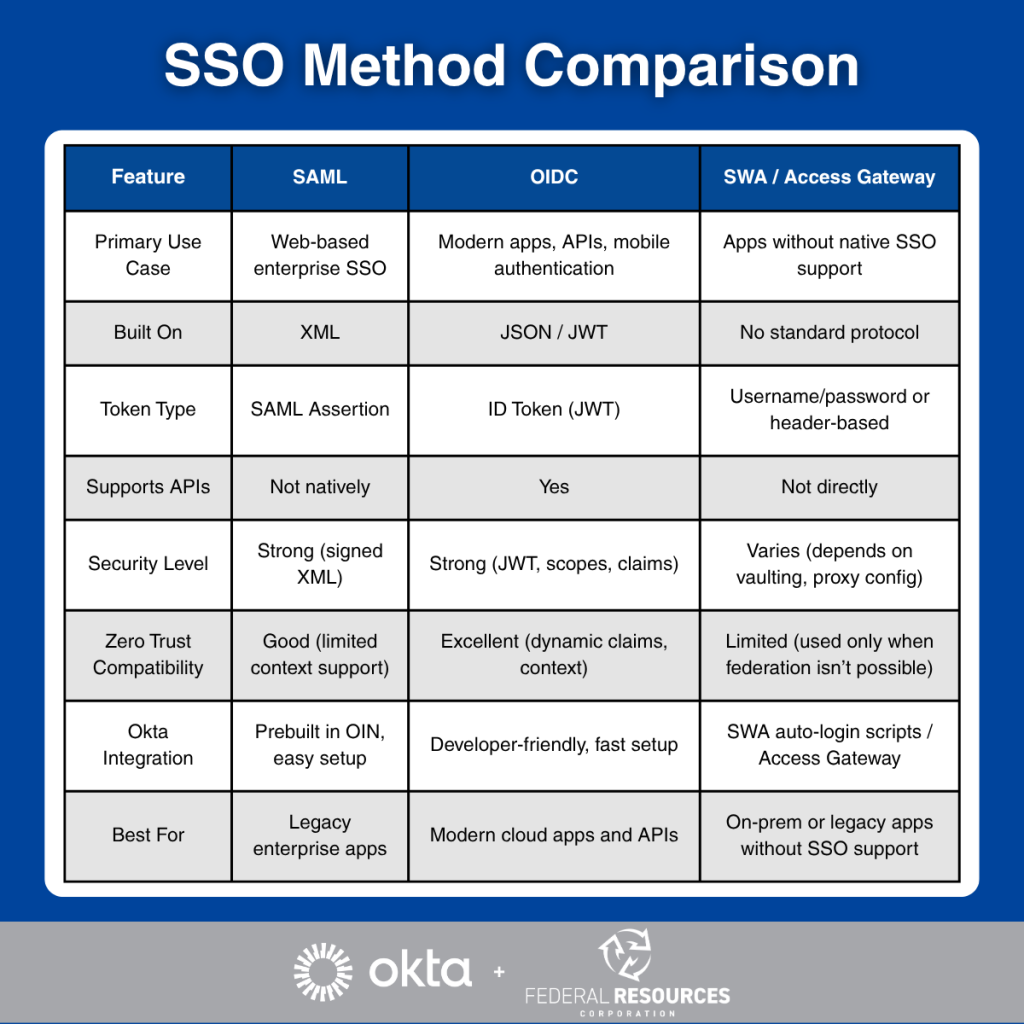
SAML is an older but widely adopted identity protocol designed primarily for web-based enterprise applications. It works by exchanging XML-based assertions between an Identity Provider (IdP) like Okta and a Service Provider (SP) like Salesforce or Workday.
When a user tries to access a service, they are redirected to the IdP to authenticate. If successful, the IdP sends a signed SAML assertion back to the service, confirming the user’s identity and possibly including user attributes like roles or groups.
SAML is ideal for legacy or SaaS applications that require browser-based access, like Workday, Salesforce, and partner portals. However, because it’s XML-based and not API-friendly, it’s a less optimal choice for mobile or modern cloud-native applications.
OIDC: The Modern Federation Protocol
OIDC (OpenID Connect) is a modern identity layer built on top of OAuth 2.0, and it’s designed with today’s application ecosystem in mind. It uses JSON Web Tokens (JWTs) and RESTful APIs, making it ideal for cloud services, APIs, and mobile apps.
With OIDC, when a user logs in, the IdP authenticates them and returns an ID token (a JWT) that contains identity claims. These tokens are lightweight, secure, and easy to validate, which is why OIDC is favored in modern development environments and Zero Trust implementations where access decisions must incorporate dynamic context.
OIDC supports modern use cases like mobile app sign-in, delegated API access, and real-time identity signals (like device security posture or geographic location). It’s great for SaaS apps like Slack or Zoom. If you’re building new apps or moving to a cloud-first model, OIDC should be your go-to.
What If My App Doesn’t Support Federated SSO?
Not all applications support modern identity federation protocols. Many legacy or on-prem apps rely on older, static login methods. Fortunately, this doesn’t mean you have to exclude them from your Zero Trust or SSO strategy.
Solutions like Okta’s Secure Web Authentication (SWA) and Access Gateway provide effective bridges:
SWA uses secure credential vaulting and browser scripting to automate logins for apps that lack federation support. Okta keeps credentials for that app inside a secure store encrypted with AES-256 encryption. Users will install an Okta plugin that simulates the sign-in process by using an SSL connection to insert and submit the user’s credentials to the sign-in page, but then deletes them after the page redirects.
Okta Access Gateway extends Okta’s identity layer to on-prem applications by acting as a reverse proxy. It accepts modern federation protocols on the front end and translates them to legacy authentication methods on the back end—ideal for apps that live behind firewalls or require header-based auth.
These fallback methods help bring every app into a unified access policy, an essential principle of Zero Trust.
Okta: Simplifying SSO Across All Protocols
One of the reasons Okta is so popular in identity and access management is its ease of use across all major protocols—SAML, OIDC, and non-federated methods. Okta provides a clean, intuitive admin console where you can configure thousands of pre-integrated apps from its Okta Integration Network (OIN) with just a few clicks.
For SAML integrations, Okta simplifies the process by auto-populating ACS URLs, Entity IDs, and certificate metadata.
For OIDC, developers can quickly spin up applications, access client credentials, set redirect URIs, and use built-in testing tools in Okta’s developer portal.
Even for apps that don’t support federation, Okta makes configuration simple using templated SWA scripts or Access Gateway configurations.
Okta’s consistent experience across different protocols allows IT and security teams to implement granular policies, enforce adaptive MFA, and maintain visibility across the access landscape—all without requiring deep customization or manual integrations.