Rethinking Trust: Cybersecurity’s Shift from Perimeter Defense to Zero Trust
The concept of trust in the digital world has significantly evolved. From relying on physical interactions to navigating complex cloud environments, cybersecurity has undergone a significant transformation. This blog post explores this evolution, focusing on the fundamental elements of trust and the shift towards a Zero Trust security model
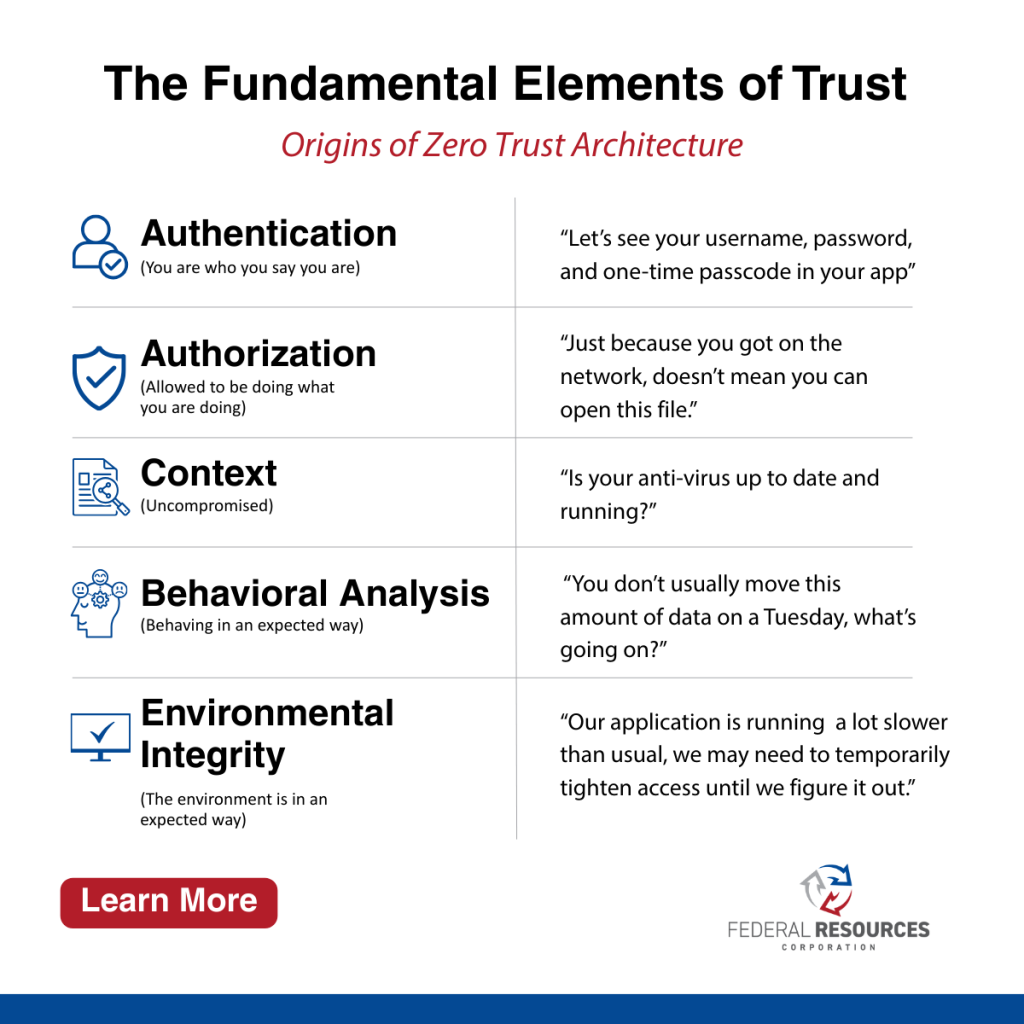
The fundamental elements of trust are:
Authentication (You are who you say you are) – Verifying identity is the bedrock of trust.
Authorization (Allowed to be doing what you’re doing) – Ensuring users/subjects have the correct permissions.
Context (Uncompromised) – Understanding the state of the system and user environment.
Behavioral Analysis (Behaving in an expected way) – Monitoring and detecting anomalies in user and system behavior.
Environmental Integrity (The environment is in an expected way) – Ensuring that the infrastructure itself is not compromised.
The Evolution of Trust Through the Eras:
The journey towards a Zero Trust security model is not a sudden leap but rather an evolution shaped by technological advancements and the changing threat landscape. To understand the principles of Zero Trust, it’s helpful to examine the distinct security paradigms that characterized different eras of computing, from the pre-digital age to the modern cloud. Let’s explore these periods and trace the shifting concepts of trust, authentication, authorization, context, behavior analysis, and environmental integrity that have led us to where we are today.
Pre-Digital Era:
Trust was primarily physical and interpersonal. This era had implicit trust within closed communities.
Authentication was based on face-to-face interactions, signatures, and physical keys.
Authorization was determined by roles and responsibilities within a physical space.
Context and behavioral analysis were limited to human observation.
Environmental integrity was about physical security of locations.
Introduction of Computers and Corporate Networks:
This era had implicit trust once you were inside the building and on the network. Once you were inside the perimeter of the network, you were trusted.
Authentication shifted to usernames and passwords, laying the groundwork for digital identity.
Authorization was managed through access control lists (ACLs) on local servers, based on roles (e.g., administrators, managers, finance, marketing, sales).
Context began to emerge with system logs, but it was rudimentary.
Behavioral analysis was limited to monitoring system uptime and basic usage.
Environmental integrity was about securing server rooms.
The Dawn of the Internet Age: This era had implicit trust similar to the previous era, but pushed the perimeter to be outside of the physical building through the use of a Virtual Private Network (VPN). Once you were on the VPN, you were trusted.
Authentication evolved to include multi-factor authentication (MFA)
Authorization faced the challenge of managing access across distributed systems.
Context became crucial as threats became more sophisticated, with the rise of malware and network intrusions.
Behavioral analysis started to incorporate network traffic analysis.
This era is shifting from implicit trust to explicit trust, meaning the system will assume you are a bad actor unless proven otherwise. Just being on the network is not enough, each request can be analyzed for access approval or denial.
Cloud computing and mobile devices and sophistication of bad actors have rendered the network perimeter insufficient.
Authentication has evolved to include advanced multi-factor authentication (MFA), biometrics, and identity and access management (IAM) systems.
Authorization is now granular, with attribute-based access control (ABAC) and policy-based access control (PBAC)
Context is paramount, including device posture. Continuous monitoring and real-time analysis are essential.
User and entity behavior analytics (UEBA) play critical roles in identifying normal and anomalous behavior.
Environmental integrity is supported by Security information and event management (SIEM) and threat intelligence
Conclusion:
Trust has evolved significantly. It has moved from a model of simple username and password verification, where network access granted implicit trust, to a dynamic, continuous process. Today, trust requires ongoing validation with each request, incorporating multiple authentication factors, device validation, and real-time behavioral analysis. This shift towards Zero Trust is essential for adapting security to the ever-changing digital landscape. A foundational understanding of trust and its evolution is crucial for effectively implementing a Zero Trust architecture..