
The Agencies That Get Zero Trust Right Will Be the Ones Who Did It in the Right Order
May 13, 2026
Moving Beyond the Quarterly (Or Yearly) Red Team
June 3, 2026The cATO model isn’t just a federal conversation. Here’s what the SLED community needs to know—and the technology that makes it possible.
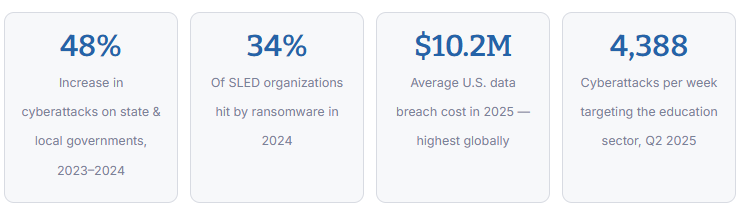
Ransomware doesn’t wait for your annual security review. Neither does a phishing campaign targeting 30,000 students’ Social Security numbers. The compliance calendar that governs most SLED cybersecurity programs was built for a slower threat landscape—and it’s showing its age in the worst possible ways.
When Bucks County, Pennsylvania’s 911 terminals went dark during a cyberattack, emergency responders had to call in the National Guard for support. When Franklin County suffered a breach exposing 30,000 residents’ sensitive personal records, those records had cleared every compliance checkpoint on the calendar. When Columbia University’s systems were compromised in June 2025, affecting nearly one million students and employees, the institution was not failing at compliance but rather failing at continuous security.
This is the compliance gap that the Continuous Authority to Operate (cATO) concept was built to close. Originally developed in the Department of Defense context, the principles of cATO—ongoing visibility, automated control validation, real-time risk awareness—are not federal abstractions. They are operational necessities for any organization responsible for citizen services, student welfare, or public trust.
And they are increasingly embedded in the mandates that govern the SLED community.
The Old Model: Periodic Assessment in a World That Never Stops
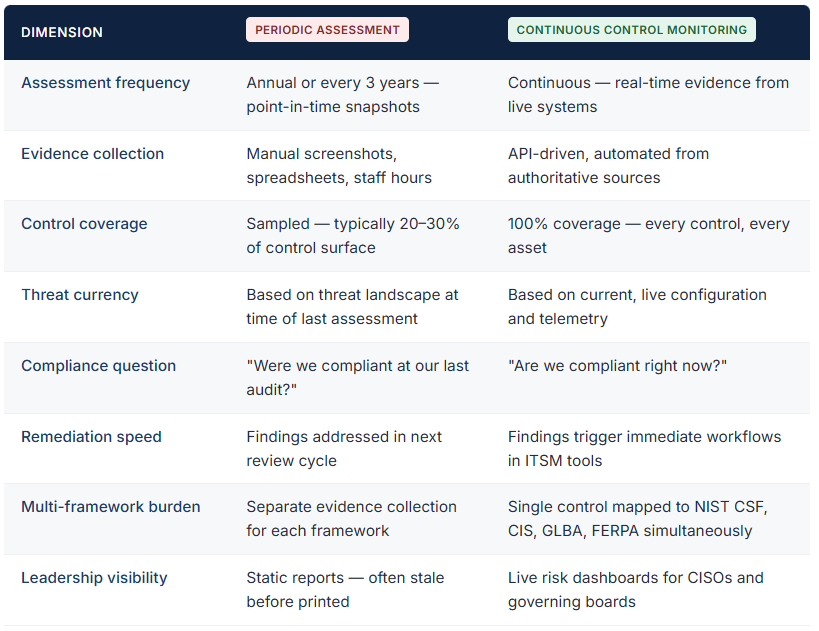
To understand why continuous control monitoring matters for SLED, start with what the traditional compliance cycle actually produces. A cybersecurity assessment is conducted. Controls are evaluated against a framework—NIST CSF, CIS Controls, or an internally defined baseline. A report is generated. Findings are remediated, or at least documented. And then, often, the organization does not look again in a systematic way for six, twelve, or even thirty-six months.
The structural failure of periodic compliance is this: a control can pass in March and fail by June. A configuration drift introduced by a routine software update. A user account that remained active after termination. A cloud storage bucket that became publicly accessible through a misconfigured permission. None of these failures announce themselves before your next audit cycle. They are discovered after the fact—often by attackers, not defenders.
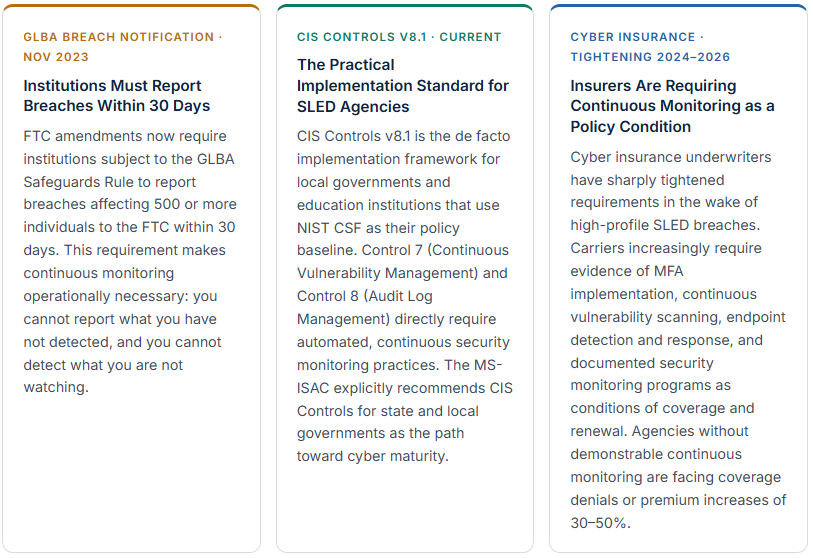
The Mandates That Are Driving the SLED Community Toward Continuous Authorization
The cATO concept emerged from the Department of Defense, but the compliance pressures pushing state and local governments and universities toward continuous monitoring are very much their own. Here is the mandate landscape that SLED technology leaders need to understand.

Who Is Affected: The SLED Compliance Picture by Segment
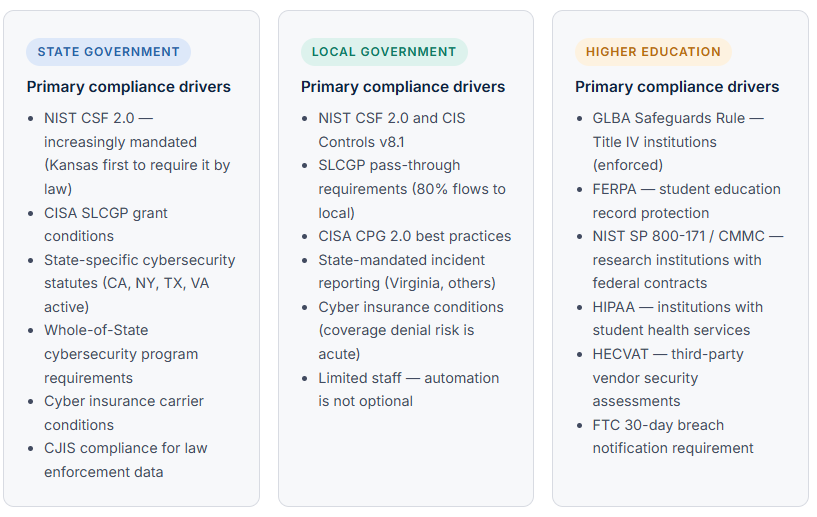
The SLED compliance problem is not one framework — it’s five. A mid-sized state university may simultaneously be subject to GLBA (financial aid), FERPA (student records), HIPAA (student health), NIST 800-171 (federal research grants), and NIST CSF 2.0 (institutional security governance). Managing these as separate compliance programs, with separate evidence collection and separate audit timelines, is administratively unsustainable and operationally dangerous.
What cATO Means for the SLED Community
The term “Continuous Authority to Operate” was coined in the DoD, but the underlying concept applies universally: moving from a model where security is assessed periodically to one where security is validated continuously.
For a state agency, cATO-equivalent maturity means an Authorizing Official—or a state CISO—can look at a live dashboard at any moment and see the current security posture of every agency system, with evidence of control effectiveness updated in real time rather than on paper from last quarter’s review.
For a county government, it means that the IT director responsible for both cybersecurity and help desk tickets (a common reality in local government) has automated systems doing the continuous control validation work that two additional FTEs would otherwise require.
For a university, it means satisfying GLBA’s requirement to “monitor and test the effectiveness of safeguards” on an ongoing basis and not just before the Department of Education’s annual audit.
The DoD defines the goal of cATO as the state achieved when an organization has demonstrated “enough maturity in maintaining a resilient cybersecurity posture that traditional risk assessments and authorizations become redundant.” That is not a federal aspiration. For any public sector organization in 2026, it is a mission-survival imperative.
Why Manual GRC Cannot Get You There
The honest assessment of how most SLED organizations currently manage compliance is uncomfortable. The SLED Cybersecurity Priorities Report found that 71% of cybersecurity leaders cite hiring challenges in building security teams. State CIOs have ranked cybersecurity as their top priority for twelve consecutive years. Yet the tools most organizations use to manage compliance—spreadsheets, manually-collected evidence, periodic penetration tests, point-in-time risk assessments—are architecturally incompatible with continuous security assurance.
Consider what continuous monitoring actually requires at the technical level:
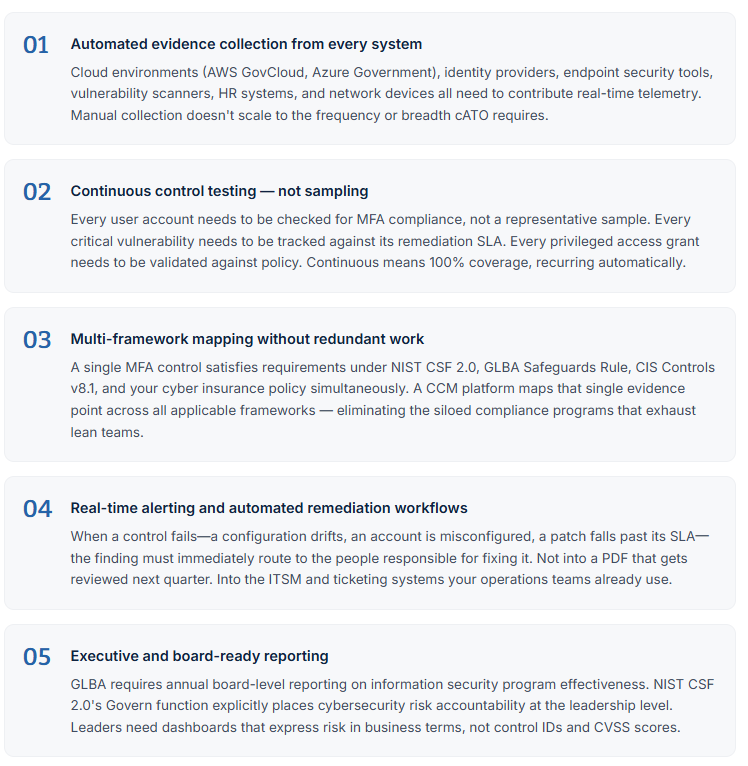
Continuous Control Monitoring: The Technical Foundation
Continuous Control Monitoring (CCM) is the technical discipline — and the platform capability — that makes continuous authorization operationally real. At its core, it operates through a three-phase cycle:
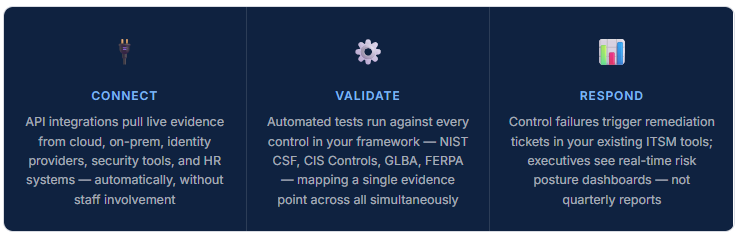
The “connect” phase eliminates the evidence-gathering burden that makes annual assessments so costly and so slow. The “validate” phase replaces sampling with certainty—every control, every asset, tested at a frequency that matches the pace of change in your environment. The “respond” phase closes the remediation loop that traditional compliance always left open.
This is what the GLBA Safeguards Rule means when it requires institutions to “regularly monitor and test the effectiveness of safeguards.” Not annually. Regularly. CCM is how you meet that requirement at scale, with the staffing you have.

Where to Start: A Practical Path to Continuous Authorization
For most SLED organizations, the journey to continuous security assurance does not begin with a platform purchase. It begins with an honest assessment of where you are. Three questions frame that starting point:
How old is your most recent security assessment? If the answer is “twelve months or more,” you are operating with a compliance posture that is almost certainly out of date. The controls that passed last year may not be passing today.
How many overlapping frameworks are you managing manually? If your team is separately collecting evidence for NIST CSF, GLBA, and your cyber insurance policy questionnaire, you are doing the same work three times and burning staff time that should be going toward remediation.
What happens when a control fails between assessments? If the honest answer is “we find out at the next audit,” you have a detection gap that attackers will exploit before your auditors will.
The path forward has three stages, regardless of organization size:
Stage 1 — Establish your baseline. Map your current controls to NIST CSF 2.0 and the specific frameworks that govern your organization. Identify your highest-risk gaps. This is where a CCM platform deployment begins — connecting to your authoritative data sources and establishing the baseline from which continuous monitoring will operate.
Stage 2 — Automate evidence collection and control testing. Replace manual evidence gathering with API-driven integrations. Stand up automated control testing for your highest-priority controls first — MFA, privileged access management, vulnerability SLAs — and expand from there. Configure alerting and remediation workflows into the ITSM tools your team already uses.
Stage 3 — Report continuously, not periodically. Replace quarterly status reports with live dashboards. Give your CISO, your board, your insurers, and your auditors access to current, evidence-backed visibility into your security posture. This is what the GLBA Safeguards Rule calls “effective safeguards monitoring.” This is what NIST CSF 2.0 calls the Govern function in practice. And this is what cATO looks like in the SLED context.
The Bottom Line
The threat landscape facing state agencies, county governments, municipalities, and universities is not waiting for annual compliance cycles to catch up. Ransomware groups have automated their targeting. Phishing campaigns run on AI-generated content. Supply chain compromises can propagate through vendor ecosystems in hours.
The mandates are catching up, too. NIST CSF 2.0, the GLBA Safeguards Rule, CISA’s SLCGP conditions, and the tightening requirements of the cyber insurance market are all moving in the same direction: away from point-in-time assessment and toward continuous, evidence-backed security assurance.
The SLED community does not need to wait for a federal authorization framework to adopt the principles of cATO. The mandate is already here — in the frameworks, in the grant conditions, in the insurance requirements, and in the breach headlines. What it needs is the technology infrastructure that makes continuous control monitoring operationally achievable with the teams and budgets that state and local government and higher education actually have.
Ready to assess your continuous monitoring readiness?
As an authorized TrustCloud partner serving the U.S. federal, state, local, and higher education market, we offer a no-obligation compliance proof of concept / proof of value. Let’s map where you are against where you need to be—and build a practical path forward.